How Much Can a Moisture Survey Save on a Commercial Roof Replacement?
When a commercial roof needs major repairs or replacement, one of the biggest questions is: How much of the existing roof actually needs to come off?
The answer can have a major impact on the project budget.
A moisture survey can help roofing contractors, building owners, and property managers identify areas of trapped moisture beneath the roof membrane—allowing them to target repairs or replacement instead of automatically removing large sections of otherwise serviceable roofing.
Depending on the size of the building and the extent of the moisture intrusion, a properly performed moisture survey can potentially save thousands—or even tens of thousands—of dollars by reducing unnecessary tear-off and helping contractors better define the scope of work.
Why Moisture Matters When Replacing a Commercial Roof
Commercial roofing systems don't necessarily fail uniformly.
A roof may have isolated areas of moisture intrusion while much of the surrounding membrane, insulation, and substrate remains in usable condition. Without a moisture survey, it can be difficult to determine exactly where those problem areas are located.
The traditional approach may involve assuming that a larger portion of the roof needs to be removed.
That's where moisture mapping can make a difference.
A moisture survey uses nondestructive testing methods to identify areas that may contain trapped moisture beneath the roof membrane. The results can then be used to create a more targeted scope of work.
Instead of:
"Tear off the entire roof."
The conversation can become:
"These specific areas contain moisture and should be addressed. The remaining roof can be evaluated for reuse."
That distinction can be significant.
How Much Can You Actually Save?
There isn't a single dollar amount that applies to every commercial roof.
The potential savings depend on several factors, including:
Roof size
Roofing system and membrane type
Amount of wet insulation
Cost of tear-off
Disposal and hauling costs
Replacement insulation requirements
Labor costs
Whether the existing roof can be partially retained
Whether the building requires a complete replacement or targeted repairs
For example, consider a 100,000-square-foot commercial roof.
If a moisture survey determines that only 15% of the roof contains significant moisture, approximately 85,000 square feet may not require the same level of removal as the affected areas.
That doesn't automatically mean 85,000 square feet can be left untouched. The roofing system still needs to be evaluated based on its age, condition, code requirements, membrane type, and the overall replacement strategy.
But identifying the actual extent of moisture gives the roofing contractor and building owner better information before the tear-off begins.
The Savings Go Beyond Tear-Off
The obvious savings from a moisture survey come from potentially reducing unnecessary removal.
But that's only part of the equation.
1. Less Tear-Off
Removing a commercial roof is labor-intensive. If wet insulation or damaged materials are concentrated in specific areas, identifying those areas beforehand can help contractors develop a more precise replacement plan.
2. Lower Disposal Costs
Roofing materials have to go somewhere after they're removed.
Every additional square foot of tear-off can mean additional dumpsters, hauling, transportation, and disposal costs.
Reducing unnecessary tear-off can therefore reduce waste and disposal expenses.
3. More Targeted Insulation Replacement
Insulation can represent a substantial portion of a commercial roofing replacement.
If moisture is confined to specific areas, the contractor may be able to focus insulation replacement where it is actually needed rather than assuming the entire roof assembly is compromised.
4. Better Project Estimates
A moisture survey can provide contractors with information that isn't obvious from the roof surface.
That information can help produce a more accurate estimate and reduce the risk of discovering extensive wet insulation only after the project is underway.
For building owners and property managers, that can mean fewer surprises.
Thermal Imaging vs. Electrical Impedance Testing
There isn't one moisture detection method that works perfectly on every roof.
At Moti Drone Services, commercial roof moisture surveys may use drone-based thermal imaging or electrical impedance testing, depending on the roofing system and site conditions.
Drone Thermal Imaging
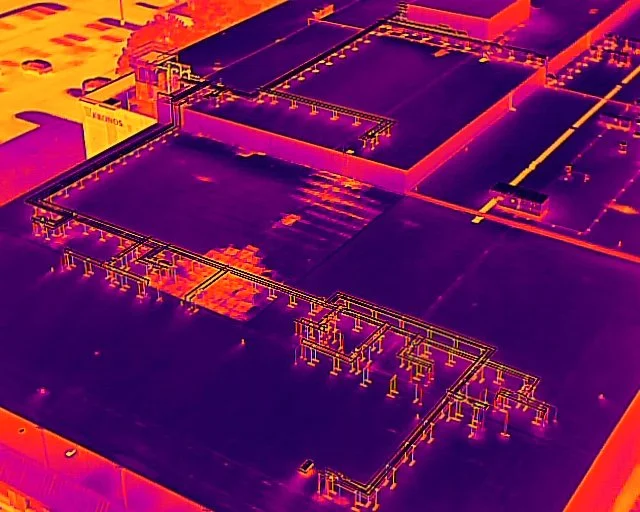
Thermal imaging looks for temperature differences associated with areas of the roof assembly that may be retaining heat differently than surrounding areas.
A typical thermal survey is performed after the roof has experienced sufficient solar heating, often during evening or nighttime hours.
Aerial thermal imaging can cover large commercial roofs efficiently while providing a visual map of thermal anomalies that warrant further investigation.
However, thermal imaging isn't appropriate for every roofing system. Certain reflective or radiant-barrier coatings, including some aluminum-coated roofs, can limit the effectiveness of thermal detection.
Electrical Impedance Testing
Electrical impedance testing provides another nondestructive method for locating potential moisture within a roofing assembly.
The equipment measures electrical characteristics of the roof system and can help identify areas that require additional investigation.
The appropriate equipment and calibration depend on the roofing system. For example, not every impedance meter is suitable for every membrane type.
That's why the survey method should be selected based on the roof—not simply because one technology is available.
A Moisture Survey Isn't a Magic "Wet or Dry" Test
It's important to understand what a moisture survey does—and doesn't—tell you.
Thermal and impedance surveys identify areas that warrant investigation. They don't eliminate the need for professional interpretation and, when appropriate, physical verification.
A good survey should be treated as part of a larger roofing assessment.
Depending on the project, suspected areas may be verified through core cuts, moisture measurements, visual inspection, or other appropriate testing methods.
The goal isn't simply to produce a colorful thermal image.
The goal is to provide useful information that helps determine what should—and shouldn't—be removed.
When Should a Contractor Consider a Moisture Survey?
A moisture survey can be particularly valuable when:
A large commercial roof is being considered for replacement
The extent of moisture intrusion is unclear
A building owner wants to avoid unnecessary tear-off
There are suspected leaks or wet insulation
A contractor needs better information before preparing a proposal
A roof has experienced repeated leaks
The roof is being evaluated for restoration versus replacement
A property owner is comparing competing replacement scopes
A warranty or insurance-related investigation requires additional documentation
For large commercial buildings, even a relatively small percentage of unnecessary tear-off can represent a significant expense.
A Small Survey Can Help Prevent a Large Mistake
A moisture survey is typically a small expense compared with the cost of replacing a commercial roofing system.
That's what makes the economics attractive.
Spending money upfront to understand the condition of the roof can potentially prevent much larger expenses later.
For contractors, it can mean developing a more defensible scope of work.
For building owners, it can mean having better information before approving a major capital expense.
And for property managers, it can provide documentation that helps explain why certain areas need replacement while others may not.
The Bottom Line
So, how much can a moisture survey save on a commercial roof replacement?
The answer depends on the roof.
But the potential savings can be substantial when moisture is isolated rather than widespread.
A moisture survey can help identify where wet insulation and other compromised areas are located, giving contractors and building owners better information to make decisions about tear-off, repairs, insulation replacement, and overall project scope.
For a 20,000-square-foot roof, that might mean thousands of dollars.
For a 100,000- or 200,000-square-foot commercial roof, the potential impact can be considerably larger.
The real value isn't simply the cost of the survey.
It's knowing what you're paying to remove before you start tearing it off.
Need a Commercial Roof Moisture Survey?
Moti Drone Services provides commercial roof moisture surveys for contractors, building owners, and property managers throughout Chicagoland and the Upper Midwest.
Depending on the roofing system and conditions, surveys can utilize drone thermal imaging or electrical impedance testing to help locate areas requiring further investigation.
If you're preparing a commercial roof replacement or want better information before developing a scope of work, contact Moti Drone Services to discuss your project.